
For hotels, energy is one of the largest controllable operating expenses. Heating or cooling unoccupied rooms quietly drains revenue every single day, reducing profitability and directly impacting Net Operating Income (NOI). As utility costs continue to rise, hotel owners and operators are increasingly searching for solutions that deliver measurable savings without disrupting operations.
Today, upgrading to a PMS-connected smart thermostat has become one of the most practical and financially rewarding investments a property can make. With utility rebate programs covering a significant portion of installation costs and modern systems requiring minimal downtime, smart energy management is no longer a future consideration—it is a present-day business necessity.
Solutions such as the DwarPaal DPCTS-1 Smart Thermostat are helping hotels reduce energy consumption, automate HVAC operations, and improve operational efficiency while maintaining exceptional guest comfort.
Why Energy Management Matters for Hotel Profitability
Hotel profitability depends not only on increasing occupancy but also on controlling operational expenses. Energy costs represent a substantial portion of a property’s monthly expenditure, particularly HVAC systems that continue operating even when rooms are vacant.
Empty rooms that remain fully heated or cooled create unnecessary utility expenses that directly affect the property’s bottom line. By implementing intelligent energy management systems, hotels can significantly reduce waste without compromising guest satisfaction.
Modern hospitality technology allows hotels to automatically adjust room conditions based on occupancy, reservation status, and guest activity, creating a more efficient and sustainable operation.
A Financial Upgrade with Immediate Returns
One of the strongest advantages of upgrading to smart thermostat technology is the availability of utility incentive programs. Many electric utility companies now offer rebate programs designed to encourage energy-efficient building upgrades.
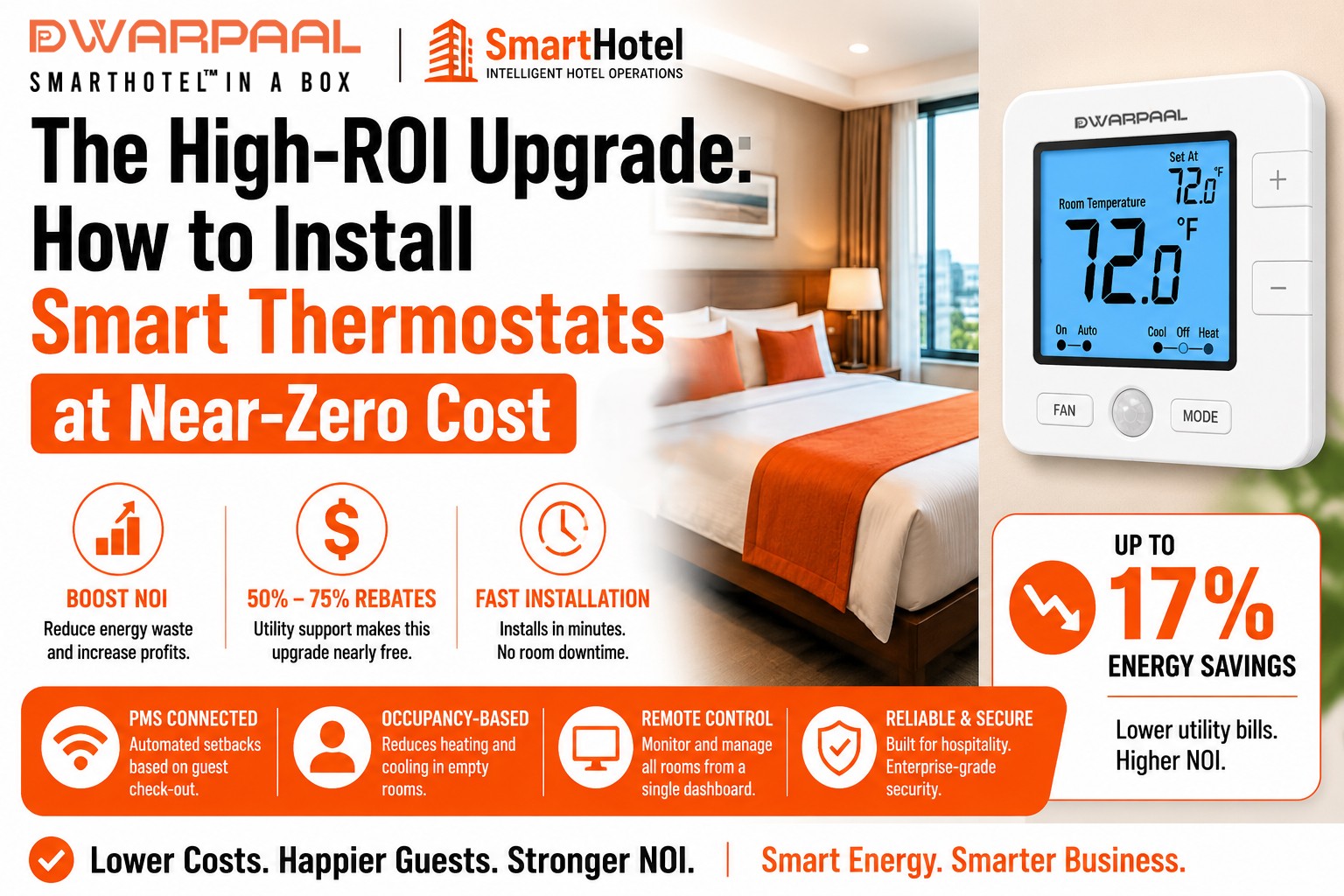
These incentives often cover between 50% and 75% of installation costs, dramatically reducing the initial capital investment required for hotels.
Combined with ongoing utility savings, these rebates create an attractive return on investment that allows many properties to recover their investment in a relatively short period.
Rather than being viewed as a large capital expense, smart thermostat installations are increasingly considered self-funding operational improvements.
Long-Term Energy Savings That Improve NOI
Beyond the initial rebate opportunities, the long-term financial impact of occupancy-based energy management creates substantial value for hotel owners.
Industry data consistently demonstrates that intelligent HVAC management can reduce energy consumption by approximately 17% through automated occupancy controls and optimized temperature management.
These savings continue to accumulate month after month, producing measurable reductions in utility costs and strengthening overall property performance.
Every dollar saved through reduced energy consumption contributes directly to improved Net Operating Income, making smart thermostats one of the most effective operational investments available to the hospitality industry.
Fast Installation Without Operational Disruption
One of the biggest concerns for hotel operators considering technology upgrades is the potential disruption to guests and room availability.
Traditional building upgrades often involve lengthy installations, extensive wiring, and temporary room closures that can affect occupancy and revenue.
Modern smart thermostat systems eliminate these concerns through simplified installation processes that require minimal room downtime.
DwarPaal’s solution connects directly to existing hotel Wi-Fi networks without requiring additional gateways or complex infrastructure changes. This allows hotels to modernize room controls quickly while keeping rooms available for guests.
Fast deployment minimizes operational interruptions and enables properties to begin realizing energy savings almost immediately.
From Manual HVAC Management to Intelligent Automation
Traditional thermostat management often relies on manual intervention by housekeeping or maintenance teams. Rooms may remain conditioned long after guests have departed, resulting in unnecessary energy usage and increased operating costs.
PMS-connected smart thermostats automate this process by integrating directly with hotel operations and occupancy data.
- Automatic HVAC setback immediately after guest checkout.
- Occupancy-based temperature adjustments.
- Real-time room monitoring and control.
- Remote management through centralized dashboards.
- Reduced dependency on manual room checks.
- Consistent guest comfort with optimized energy usage.
By eliminating manual processes, hotels improve efficiency while ensuring guests always experience comfortable room conditions during their stay.
Remote Monitoring and Property-Wide Visibility
Modern hotel operations increasingly depend on centralized management tools that provide real-time visibility into property performance.
Smart thermostat platforms allow operators to monitor temperatures, occupancy conditions, and HVAC performance across the entire property from a single dashboard.
This level of visibility enables hotel teams to respond quickly to operational issues, optimize energy usage, and maintain consistent comfort standards throughout the property.
Remote monitoring also reduces the need for physical room inspections, allowing staff to focus more on guest service and operational priorities.
Sustainability and Future Hospitality Standards
Energy efficiency has become an increasingly important component of hotel operations, not only for financial reasons but also to meet evolving sustainability expectations.
Guests, brands, and industry standards are placing greater emphasis on environmentally responsible operations. Hotels that adopt intelligent energy management systems position themselves for future sustainability requirements while reducing their environmental impact.
Smart thermostat technology supports these goals by minimizing unnecessary energy consumption and promoting more efficient building operations.
The Bottom Line
Smart energy management is no longer simply an engineering upgrade. It has become a strategic investment that directly influences profitability, operational efficiency, and long-term property performance.
With substantial utility rebates, fast installation, occupancy-based automation, and continuous energy savings, PMS-connected smart thermostats provide one of the strongest returns on investment available to hotel owners today.
As hotels continue to focus on operational efficiency and sustainable growth, intelligent energy management solutions offer a practical and proven pathway to reducing utility costs, improving NOI, and delivering better guest experiences.