
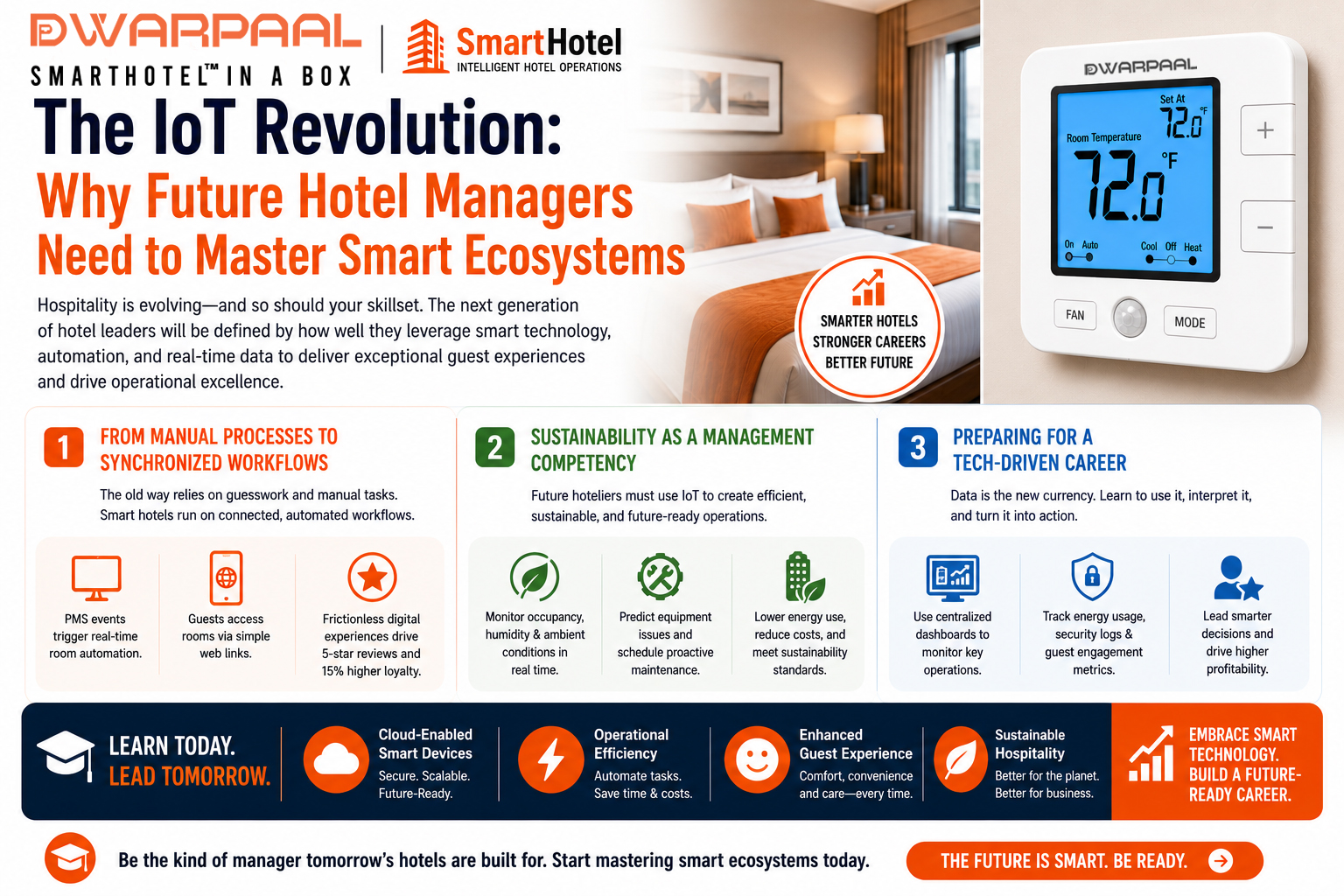
The hospitality industry is undergoing one of the most significant transformations in its history. While exceptional service and guest satisfaction remain at the heart of hotel operations, the definition of hospitality excellence is rapidly evolving. For students of hotel management and aspiring hospitality leaders, understanding smart hotel technology is becoming just as important as mastering traditional service standards.
As hotels increasingly adopt automation, connected devices, and data-driven decision-making, the next generation of managers will be expected to understand Smart Hospitality Platforms and use technology to create memorable guest experiences.
The future of hospitality belongs to professionals who can combine human-centered service with intelligent hotel technology to deliver operational efficiency, sustainability, and personalized guest experiences.
The Evolution of Hospitality Management
Traditional hotel operations relied heavily on manual processes and human intervention. Housekeeping teams manually updated room status, front desk staff managed physical keys, and engineering teams handled HVAC settings room by room.
While these processes served the industry for decades, modern hotels now require faster, more efficient, and more connected workflows to meet growing guest expectations.
Today’s hospitality leaders must understand how technology, automation, and operational data work together to create a seamless guest experience.
From Manual Processes to Synchronized Workflows
Modern hotel operations are increasingly driven by synchronized workflows that connect multiple systems across the property.
Property Management Systems (PMS), smart locks, occupancy sensors, thermostats, and guest engagement platforms now communicate with one another to automate routine tasks and improve operational efficiency.
For future hotel managers, understanding how a PMS event such as guest check-in or check-out triggers room automation is becoming an essential skill.
Connected hospitality platforms allow hotels to:
- Automate room access and guest entry.
- Optimize room temperature based on occupancy.
- Reduce manual operational tasks.
- Improve communication between departments.
- Enhance overall guest satisfaction.
DwarPaal’s smart hospitality architecture enables guests to access rooms through secure web links, eliminating the need for complicated application downloads and reducing friction during the guest journey.
These seamless digital experiences directly contribute to stronger guest satisfaction, improved online reviews, and increased loyalty.
The Importance of Guest Experience Technology
Modern travelers expect convenience, personalization, and instant access to services. Technology now plays a major role in shaping guest perceptions throughout the stay.
Future hospitality professionals must understand how digital experiences influence:
- Guest satisfaction scores.
- Online reviews and ratings.
- Brand loyalty.
- Repeat bookings.
- Revenue growth opportunities.
By understanding guest engagement technologies, future managers can create experiences that not only satisfy guests but also strengthen long-term business performance.
Sustainability as a Core Management Competency
Sustainability is no longer considered an optional initiative within the hospitality industry. Environmental responsibility is rapidly becoming both a regulatory requirement and a guest expectation.
Hotels worldwide are adopting energy-efficient technologies to reduce operational costs and meet emerging sustainability standards.
Future hoteliers must become familiar with:
- IoT-based temperature control systems.
- Occupancy-based energy management.
- Humidity and environmental monitoring.
- Energy consumption analytics.
- Sustainability reporting and compliance.
Learning how to manage these systems enables future hospitality leaders to reduce energy waste, improve operational efficiency, and contribute to long-term environmental goals.
Predictive Maintenance and Operational Efficiency
One of the most valuable benefits of smart hospitality technology is predictive maintenance.
Connected devices continuously monitor equipment performance and environmental conditions, allowing operators to identify potential issues before they become costly failures.
Predictive maintenance helps hotels:
- Reduce unexpected equipment breakdowns.
- Lower maintenance costs.
- Improve HVAC performance.
- Extend equipment lifespan.
- Maintain consistent guest comfort.
For hospitality students and professionals, understanding how data supports maintenance decisions is becoming increasingly important.
Data-Driven Decision Making in Hospitality
Data is becoming one of the most valuable assets within modern hotel operations. Managers who can interpret and act on operational data will play a critical role in shaping the future of the industry.
Centralized dashboards now provide real-time insights into:
- Energy consumption.
- Occupancy patterns.
- Security and access logs.
- Guest engagement metrics.
- Operational performance.
By analyzing this information, hotel managers can make informed decisions that improve efficiency, increase revenue, and enhance the guest experience.
Preparing for a Technology-Driven Hospitality Career
The rise of Smart Hotels is creating new opportunities for hospitality professionals. Technical knowledge, operational analytics, and digital guest experience management are becoming essential skills for future leaders.
Students who understand connected hotel technologies will be better prepared to work within modern hospitality environments where automation and data support every department.
Cloud-enabled platforms, smart room technologies, and integrated operational systems are rapidly becoming standard across the industry.
The Future of Hospitality Leadership
The hospitality industry will always depend on human interaction, empathy, and service excellence. However, the next generation of leaders must also understand how technology supports these values.
By embracing smart hospitality solutions and connected technologies, students and hospitality professionals position themselves at the forefront of a more efficient, sustainable, and guest-centric industry.
As Smart Hotels continue to evolve, future managers who combine operational knowledge with technological expertise will lead the industry’s most innovative and profitable brands.