
In today’s hospitality industry, success is no longer measured solely by occupancy rates. Modern hotel owners and operators are increasingly focused on one critical financial metric: Net Operating Income (NOI). Rising utility costs, labor shortages, and increasing guest expectations have made operational efficiency more important than ever.
This shift has accelerated the adoption of the Smart Hotel in a Box approach—a fully integrated hospitality technology ecosystem designed to reduce operating costs, increase revenue opportunities, and improve guest satisfaction simultaneously.
By combining smart energy management, intelligent room controls, guest engagement platforms, and automation tools, hotels can significantly improve profitability while building a more sustainable operation.
Why Hotel NOI Matters More Than Ever
Net Operating Income represents the true financial performance of a property. While increasing occupancy remains important, reducing operational expenses often produces faster and more sustainable gains.
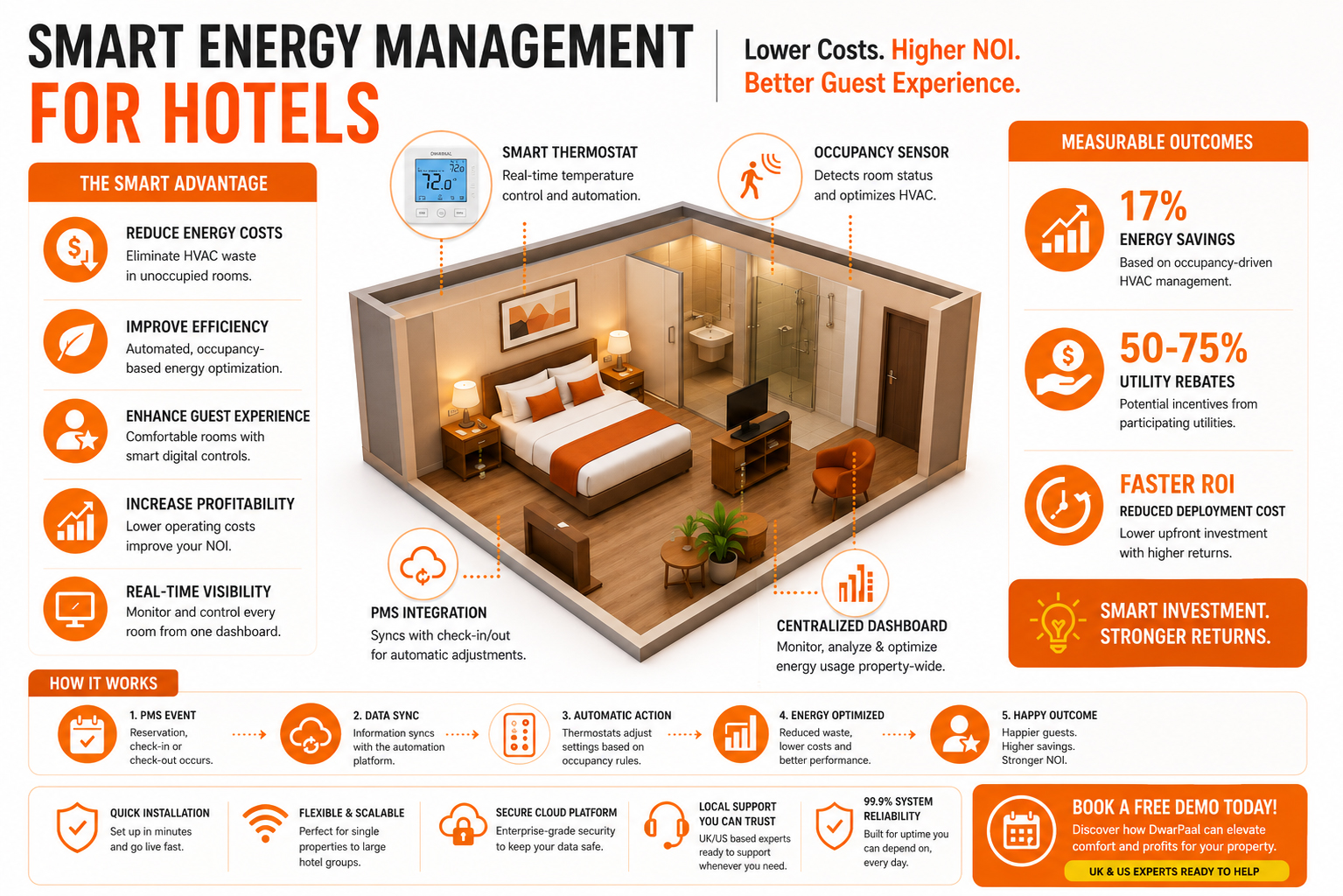
Energy expenses alone can account for 20% to 30% of a hotel’s operational costs. Heating, ventilation, and air conditioning (HVAC) systems represent one of the largest contributors to these expenses, especially when rooms remain conditioned despite being unoccupied.
Every empty room that continues to consume energy directly impacts profitability. This is where intelligent hotel automation delivers measurable financial results.
Smart Energy Management: Turning Costs into Savings
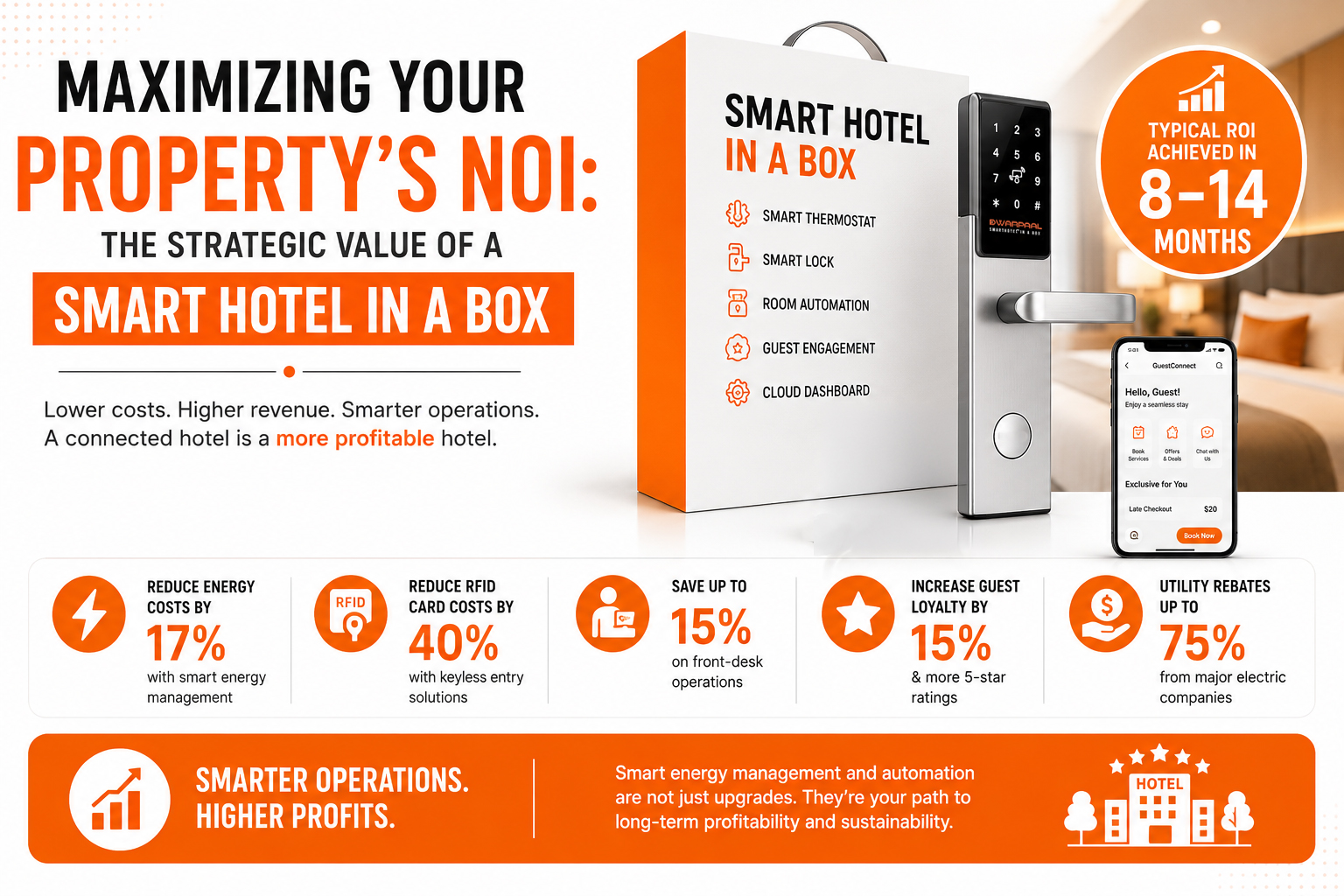
Occupancy-based energy management has become one of the most effective methods for reducing hotel operating expenses. Industry studies indicate that hotels implementing smart HVAC controls can achieve energy savings of up to 17%.
The DwarPaal DPCTS-1 Smart Thermostat is specifically designed for the hospitality industry and integrates directly with hotel Property Management Systems (PMS). This integration enables rooms to automatically transition into energy-saving mode immediately after guest checkout.
Instead of relying on housekeeping or front-desk staff to manually adjust temperatures, the system intelligently manages room conditions based on occupancy status.
- Automatic setback temperatures during vacancy.
- Reduced HVAC runtime and energy consumption.
- Improved equipment lifespan through optimized operation.
- Consistent guest comfort upon arrival.
- Lower maintenance requirements.
Lower Capital Costs Through Utility Rebates
One of the strongest business cases for smart thermostat deployment is the availability of utility incentive programs. Many electric utility companies provide rebates covering between 50% and 75% of installation costs for approved energy-efficient technologies.
These rebates significantly reduce the initial capital investment, making smart thermostats one of the fastest-returning upgrades available to hotel owners.
When combined with ongoing energy savings, these incentives allow many properties to achieve a complete return on investment within a relatively short period.
Generating Additional Revenue Through Guest Engagement
A smart hotel does not only reduce expenses—it creates new revenue opportunities.
Modern guest engagement platforms such as GuestConnect enable hotels to communicate with guests before, during, and after their stay through Email, WhatsApp, and SMS.
Automated communication workflows help properties:
- Promote room upgrades.
- Offer late check-out services.
- Upsell dining and spa experiences.
- Encourage repeat bookings.
- Increase guest satisfaction and loyalty.
Hotels implementing these engagement strategies often experience revenue improvements of approximately 10% through personalized upselling and improved guest retention.
Operational Efficiency Across the Entire Property
The Smart Hotel in a Box approach extends beyond energy management. Connected systems work together to reduce labor requirements and streamline operations.
Keyless Entry Solutions
Digital key systems reduce the ongoing expense of RFID cards while improving convenience for guests. Many properties report up to 40% savings in card-related costs.
Automated Front Desk Operations
Self-service technologies, automated workflows, and integrated systems can reduce front-desk workload, resulting in approximately 15% operational savings.
Synchronized Room Controls
Connected thermostats, occupancy sensors, and room automation create a seamless guest experience. Hotels implementing these systems often see:
- Higher guest satisfaction scores.
- Increased online ratings.
- Greater guest loyalty.
- Improved brand reputation.
- More repeat business.
The ROI of a Smart Hotel in a Box
Hotel technology investments are increasingly evaluated through financial performance rather than technological features alone. The Smart Hotel in a Box model delivers measurable returns through:
- Reduced energy consumption.
- Lower labor costs.
- Increased ancillary revenue.
- Improved guest retention.
- Reduced maintenance expenses.
- Higher operational efficiency.
Most properties implementing integrated smart hospitality solutions achieve a return on investment within 8 to 14 months, making it one of the most attractive capital improvements available to hotel owners today.
The Bottom Line
Smart energy management and hotel automation are no longer optional upgrades—they are essential financial strategies for modern hospitality operations.
By adopting a Smart Hotel in a Box approach, hotel owners can reduce operating costs, improve guest experiences, increase revenue opportunities, and strengthen long-term profitability.
In an increasingly competitive hospitality market, connected technology provides a practical and proven pathway to maximizing NOI while preparing properties for a more sustainable and efficient future.