In today’s hospitality market, controlling operating costs is just as important as driving occupancy. One of the biggest controllable expenses for hotels is energy. When heating and cooling systems continue running in empty rooms, hotels lose money every single day. That is where smart energy management for hotels becomes a game-changer.
By combining connected thermostats, occupancy-based controls, PMS integration, and centralized monitoring, hotels can reduce energy waste, improve room comfort, and increase profitability. DwarPaal’s hotel automation ecosystem is built to support exactly this kind of connected operation, bringing together room controls, PMS-linked workflows, reporting dashboards, guest interfaces, and cloud-connected devices into one smart hospitality platform.
Why Hotels Need Smart Energy Management
Many hotels still rely on manual room control processes. After checkout, room temperatures may stay unchanged for hours. Staff may need to manually adjust HVAC settings, and there is often little visibility into which rooms are consuming more energy than necessary.
These inefficiencies create avoidable costs such as:
- Cooling or heating vacant rooms unnecessarily
- Delays in resetting rooms after checkout
- Dependence on staff to manage room settings manually
- Limited insight into room-level energy behavior
- Higher utility overhead across the property
A hotel energy management system solves these issues by automating how rooms consume power based on occupancy, booking status, and operating rules.
How Smart Energy Management Works in Hotels
A true smart setup does more than control temperature. It connects energy decisions with the hotel’s daily operations.
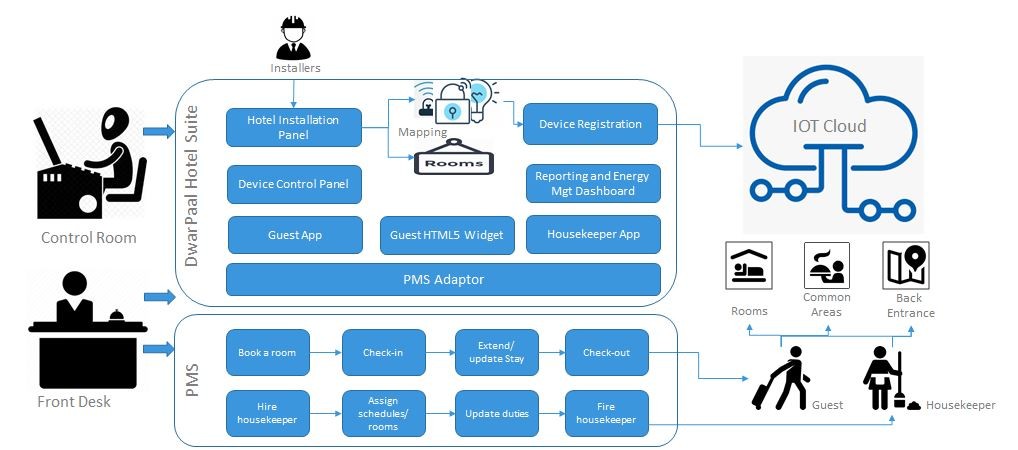
DwarPaal’s hotel workflow and platform architecture show how PMS events such as booking, check-in, stay updates, and checkout connect with room automation, device control, dashboards, and guest-facing tools. This makes energy management part of hotel operations rather than a separate manual task.
With this approach, a smart system can:
- Automatically adjust HVAC after guest checkout
- Use occupancy sensing to reduce energy waste in empty rooms
- Allow remote monitoring and control of room temperatures
- Reduce dependency on housekeeping for room energy resets
- Improve consistency across all rooms
This kind of hotel HVAC automation helps properties operate more efficiently without compromising guest comfort.
The Role of Smart Thermostats in Reducing Hotel Energy Costs.
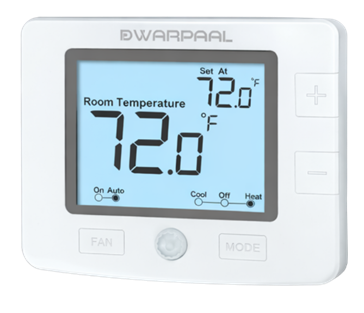
Smart thermostats are at the center of modern hotel energy savings. DwarPaal’s DPCTS-1 smart thermostat is positioned as a PMS-connected solution that installs quickly, connects to hotel Wi-Fi, enables occupancy sensor-based energy management, and allows remote room temperature monitoring and control. Its product material also highlights 17% energy savings based on industry standards and 50% to 75% rebate support from major electric companies.
This matters because a hotel smart thermostat can help properties:
1. Cut waste in unoccupied rooms
When a guest leaves or checks out, the thermostat can automatically reduce unnecessary HVAC usage.
2. Automate post-checkout setbacks
Instead of waiting for staff action, the PMS-connected system can trigger room temperature changes immediately after checkout. DwarPaal specifically notes this PMS-driven HVAC automation and highlights that hotels no longer need to depend on housekeeping to save energy.
3. Monitor performance remotely
Operators can view and control temperatures across rooms without physically entering them.
4. Improve project economics with rebates
Utility rebate support can lower adoption cost and shorten payback timelines. DwarPaal’s thermostat sheet indicates rebate support ranging from 50% to 75%.
How Smart Energy Management Improves NOI
For hotels, NOI improvement comes from reducing controllable costs while maintaining or improving guest satisfaction. Energy savings go directly to the bottom line, which makes smart automation one of the most practical ways to improve operating performance.
When a hotel reduces HVAC waste across dozens or hundreds of rooms, the result is lower utility overhead month after month. Since this affects recurring expenses, the impact on profitability compounds over time.
This is why smart energy management for hotels is not just an engineering upgrade. It is a financial strategy.
Better Guest Experience Alongside Better Efficiency
Reducing costs should never mean reducing comfort. The best hotel energy solutions improve efficiency in ways that the guest does not feel negatively.
Smart systems can keep rooms comfortable while using occupancy logic and PMS data to reduce waste only when the room is vacant or unoccupied. DwarPaal also notes that guests can operate room settings using a simple web link without downloading an app, which can make in-room control easier and more convenient.
DwarPaal’s broader guest engagement materials also associate digital room experiences with outcomes such as more 5-star ratings, 10% more revenue, and 15% more loyalty, showing that connected hotel technology can support both operational savings and guest-facing value.
Why PMS Connectivity Makes a Difference
A standalone thermostat can help reduce energy use. A PMS-connected thermostat can do much more because it knows when a guest is arriving, staying, extending, or checking out.
This integration helps hotels automate energy logic based on live room status instead of manual assumptions. It also helps staff work faster by removing repetitive room reset tasks and improving process consistency.
That is one of the biggest advantages of DwarPaal’s connected platform: room devices, guest workflows, and hotel operations all work together instead of functioning in silos.
Fast Installation Supports Faster ROI
Hotels often delay upgrades because they worry about installation complexity and room downtime. DwarPaal’s thermostat product sheet addresses this by stating that the system installs in minutes, requires no running wires in the room, and connects directly to hotel Wi-Fi without a gateway.
Conclusion
Hotels looking to reduce utility overhead and improve profitability should treat energy automation as a strategic priority. A connected hotel energy management system can help reduce energy waste, streamline room operations, improve guest comfort, and strengthen NOI over time.
With PMS-connected automation, occupancy-based control, remote monitoring, and utility rebate potential, DwarPaal offers a smart path for hotels ready to modernize energy operations and improve property performance.